
Care as a Public Service:
a Study Circle for Espoo Civil Servants
Sign up if interested by August 21st.
- Do you work with migrant residents or other underserved resident groups?
- Do you work with digital services and feel uneasy about the role of public sector digitalisation?
- Do you strive to apply more co-creative approaches in your work?
- Do you want to learn about how to make public services more care-centric?
- Do you feel like you’re lacking support to address all of this?
Welcome to join a study circle in the fall!
A well-functioning city is built on trust between residents and public institutions. One of the findings of the Trust-M research project is that trust cannot be designed, but it can be cultivated through different feelings of affects. One underlying affect is care, which can support not only trust but belonging for residents who do not feel heard. Care is difficult to implement in the current system and organisational culture, which is built on efficiency measures, precarious public funding in ever changing political context. At the same time, we have seen many efforts towards more caring public services in Espoo already, so there is potential to build on those. With this initiative, we propose a study circle – a space to learn about care and put it to practice in a small group.
Espoo as a caring organisation
Espoo has set one of the strategic goals (Espoo tarina) to be about the wellbeing of staff. Drawing from care literature, it is important to recognise one’s own care needs before taking care of others. Through intentionally adding moments of reflection in a civil servant’s busy schedule, this initiative can act as a novel way of introducing more internal, as well as external care at work. In the future, this could become a competence development program, and can add to the overall organisational shift towards a more caring work culture.
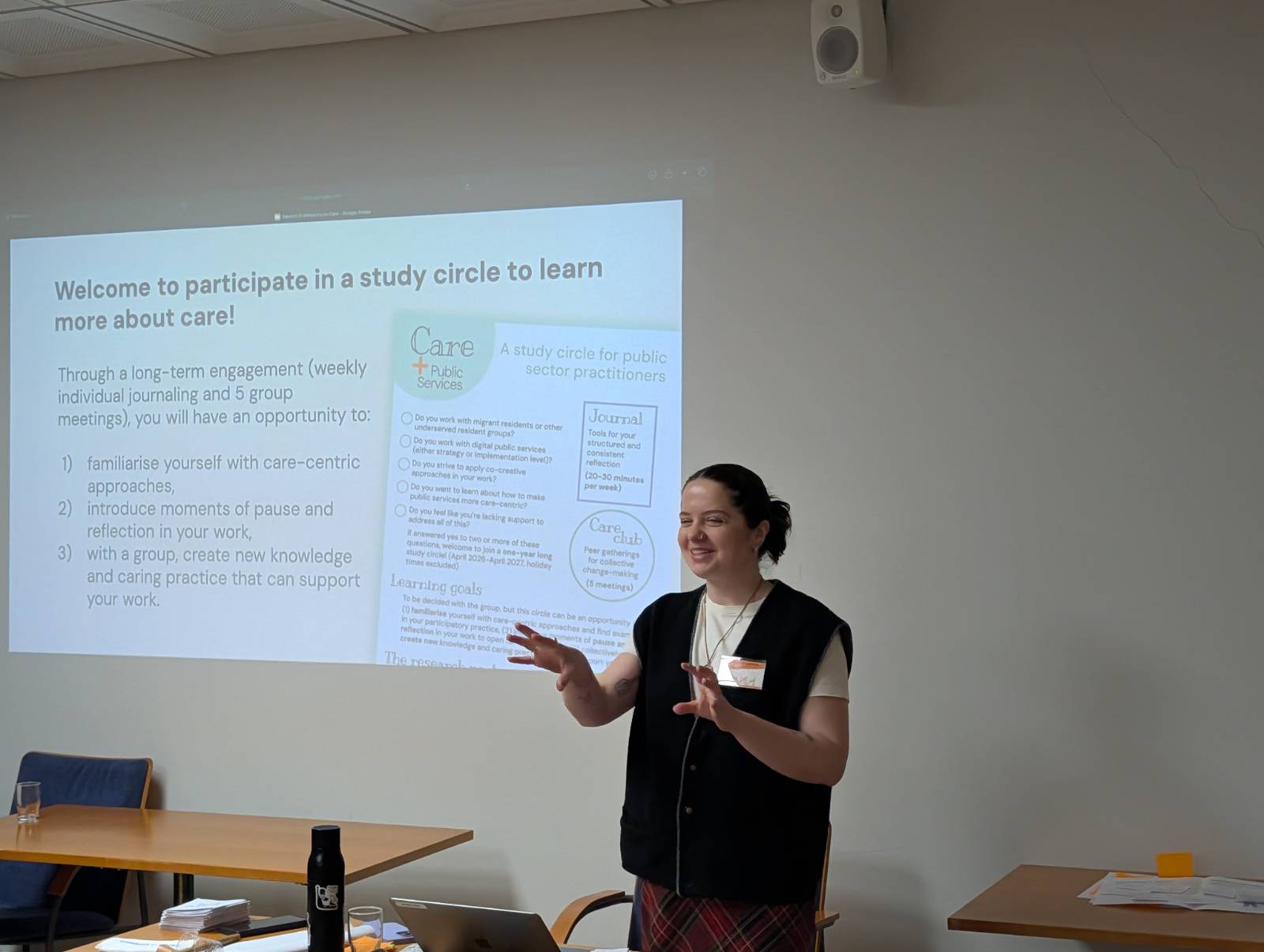
Additionally, this introduces a new way for research-city collaboration which is very direct, as the researcher learns together with the civil servants, based on participatory design principles. Study circles are usually a form of informal education with no teacher but a facilitator to learn about a shared interest. However, we are trying to formalise it just a little bit in Espoo, so it would be easier for people to attend this as part of their working time.
Who can participate?
This study circle is meant for public sector practitioners to learn about things like care, participation, and belonging in a group setting. By joining, civil servants will get 1) tools for a structured and consistent reflection (such as journaling), and 2) a peer-support group. At the same time, they will be participating in a research study, looking into how practitioners exercise care, when designing and implementing public services.
Any Espoo employees can join the circle, for example, people working with: migrant residents or other underserved resident groups, digital transitions, service design, co-creation, participatory approaches. And people who are curious about care topics!
Learning goals
To be decided with the group, but this circle can be an opportunity to (1) familiarise yourself with care-centric approaches and find examples in your participatory practice, (2) introduce moments of pause and reflection in your work to open up space for care, (3) collectively create new knowledge and caring practice that can support your work.
The research part
With a separate agreement, the participants of the study circle will be joining a research study, which explores how practitioners exercise care when designing public services. The researcher will be learning together with the group, while at the same time facilitating the program and providing the tools.
Plan and timeline
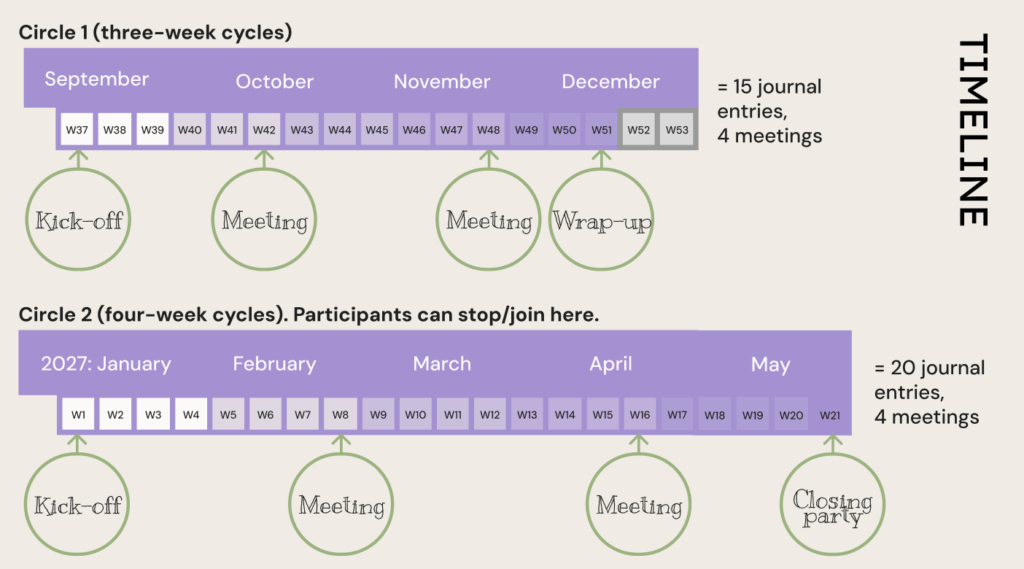
Participation includes several months of continuous engagement (excluding winter holidays): 20-30 minutes per week for individual tasks, and four or eight 60-90 minute group sessions. The first study circle will take place between September (w37) and December (w51) and will focus on perfecting the method itself, iterating the journal and collecting topics that require more in-depth discussion. After the first circle, people can choose whether to continue with the next one. We will welcome new members for the second iteration.
The second study circle will take place between January (w1) and May (w21) and will invite for more in-depth reflections and conversations on care.
Both circles are divided in five parts, based on care theory (J. Tronto’s dimensions of care): attentiveness, responsibility, competence, responsiveness, and solidarity.
The group meetings will take place in person, to better include emotional and embodied aspects of our discussions. The facilitation will happen in English. The locations will be decided together, between Espoo buildings, Aalto university Otaniemi campus, and public spaces such as libraries.
❗The first meeting is planned for September 8th, 10:00-12:00 in Otaniemi (specific location TBA). Everyone is welcome to join this without any commitments.
How to participate?
At least the first study circle (September-December) will be treated as “learning at work”, however, manager’s approval to participate is advisable. On the way, we can decide together whether a more formalised training would aid the participation.
Anyone can drop out at any point if it becomes too much!
We practice confidentiality, discretion, and care in our group meetings, and it is not required to share every journal entry with the rest of the group, and some parts can be retracted from research too.
Registration form, sign up by August 21st:
The first meeting: September 8th, 10:00-12:00 in Otaniemi (specific location TBA)
Contact:
Rūta Šerpytytė
Doctoral researcher, Trust-M project
Tampere University/Aalto University
ruta.serpytyte (at) tuni.fi
See related publication: